
Core service
Manned guarding and SIA licensed security officers
SIA-licensed security officers for construction sites, commercial premises, vacant property and access control across London and the Home Counties.
A security officer on site does two jobs. The visible one is deterrence: an occupied, watched property is a harder target than an empty one, and most opportunistic crime goes elsewhere. The less visible one is judgement: knowing which vehicle at the gate does not belong, noticing that a fire door has been wedged, and deciding what actually warrants a call at two in the morning.
The second job is what separates one guarding contractor from another, and it is the reason vetting and shift length matter more than headcount. An officer twelve hours into a badly planned shift is physically present and functionally absent.
Who we put on your site
Every officer holds a current SIA licence, and we will provide the licence numbers for the personnel assigned to your site so you can check them yourself. That is a reasonable thing to ask of any contractor, and a contractor who resists it is telling you something useful.
We assign officers to sites rather than filling shifts from a pool wherever possible. An officer who has worked your property before knows which doors stick, which contractor turns up early, and what normal looks like, which is the only reliable way to notice abnormal.
TODO(owner): if staff are vetted to BS 7858 (the British Standard for screening security personnel), state it here, it is a common procurement requirement and worth naming explicitly. Not claimed until confirmed.
Access control and gate duties
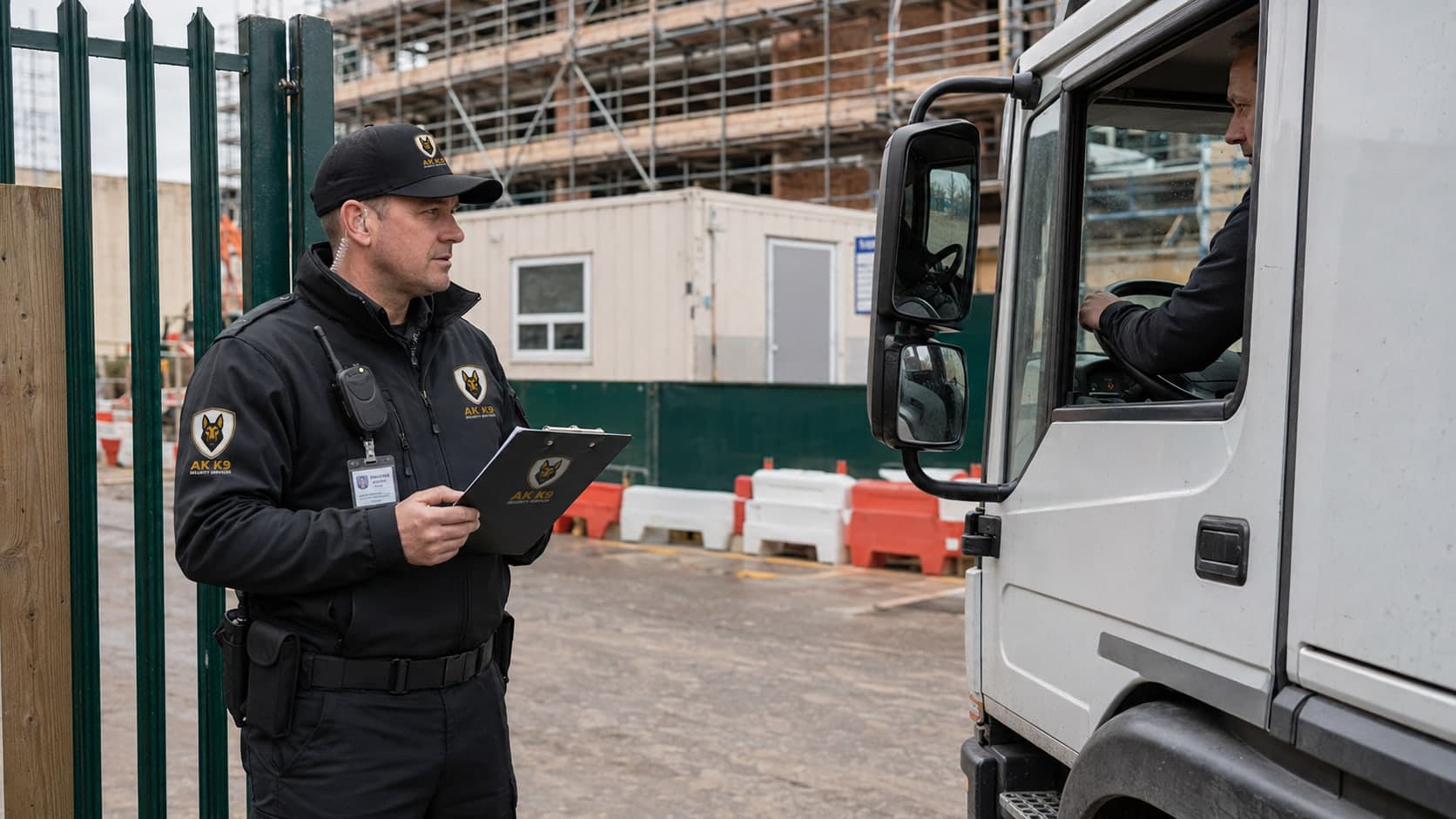
On active sites, controlling who comes in is usually more valuable than patrolling. We operate signing-in procedures, check contractor credentials and inductions, log deliveries and vehicles, and hold the line on site rules that everyone else finds inconvenient, which is precisely why an outside contractor is better placed to enforce them than one of your own team.
Where the site is running a permit regime, or where subcontractors need escorting, we work to whatever process you already have rather than imposing our own paperwork on top of it.
Patrolling, reporting and escalation
Patrols are worked to a schedule built from the site survey and varied in timing, so the pattern is not learnable from outside the fence. Officers check perimeters, plant and material stores, fire points and any area the survey flagged.
Everything is written down. Patrol times and routes, anything found and what was done about it, visitors and vehicles, and any incident with times and names. The point of a report is that somebody else, your insurer, your client, or the police, can rely on it later.
Escalation is agreed before the first shift: what an officer handles alone, what triggers a call to you, and what goes straight to the emergency services. Nobody should be improvising that at three in the morning.
Sectors we provide this for
- Construction
- Gatehouse, induction checks, delivery control and contractor management on active sites.
- Commercial and offices
- Out-of-hours cover, reception and front-of-house where the role is partly public-facing.
- Retail and warehousing
- Loss prevention, goods-in supervision and closing procedures.
- Vacant property
- Visible occupation where a presence is the deterrent and patrols alone are not enough.
- Industrial and manufacturing
- Access control across multiple gates, plus contractor and permit management.
- Education and healthcare
- Environments where manner matters as much as vigilance, and vetting standards are scrutinised.
Static officer or mobile patrol: which does your site need?
These are priced very differently and they solve different problems. Buying the wrong one is the most common mistake we see.
A static officer fits when
access needs controlling continuously, there are deliveries or contractors through the day, or the value of the presence is that somebody is always there. Anything happening between visits is the risk a static officer removes.
Mobile patrols fit when
the site is lower risk, you have several premises to cover, or patrols are supplementing other measures like alarms and cameras. Cheaper per site, but everything between visits is unobserved.
Neither is enough when
the real problem is that nobody is monitoring the alarm or the cameras. Adding a patrol to a site whose alarm nobody answers does not fix the gap.
If a loss would be material, pay for continuous cover. If you are managing a portfolio of lower-risk sites, patrols spread the budget further. Be wary of a patrol schedule that never varies, because a fixed route is a timetable anybody can observe.
Areas we cover for manned guarding and sia licensed security officers
We work across London, Hertfordshire, Bedfordshire and Buckinghamshire. These are the areas with a dedicated page, and there is local detail on each rather than the same text with the place name changed.
An officer twelve hours into a badly planned shift is physically present and functionally absent. Shift design is a security control, not an HR detail.
Typical deployments
- Construction site gatehouse, induction checks and delivery control
- Overnight and weekend cover for commercial premises and offices
- Vacant property watch where a visible presence is the deterrent
- Retail and warehouse loss prevention
- Reception and front-of-house security with a public-facing role
- Temporary cover during strikes, disputes, or after an incident
Compliance
All officers hold current SIA licences. Assignment instructions, patrol schedules and reporting formats are agreed in writing before deployment.
Tell us about the site
Send us the property, the hours you need covered and anything that has already happened there. We will come back with a survey date and an honest view of what the site actually needs.