
Sector service
Construction site security
Overnight and weekend cover for construction sites across London and the Home Counties: dog units, static officers, gatehouse control and plant protection.
Construction sites are targeted deliberately rather than opportunistically. Plant, cable, copper, fuel and power tools have an immediate resale value, they are portable, and a site plan can be worked out from outside the hoarding in an afternoon. That is why theft from sites tends to happen in the small hours of a Sunday rather than at random.
Because the theft is planned, it is planned around whatever security is visible. A fixed patrol time, a camera pointed at a floodlight, or a gate that is only manned during deliveries all get factored in. Security that works on a construction site is security that cannot be timed from the pavement.
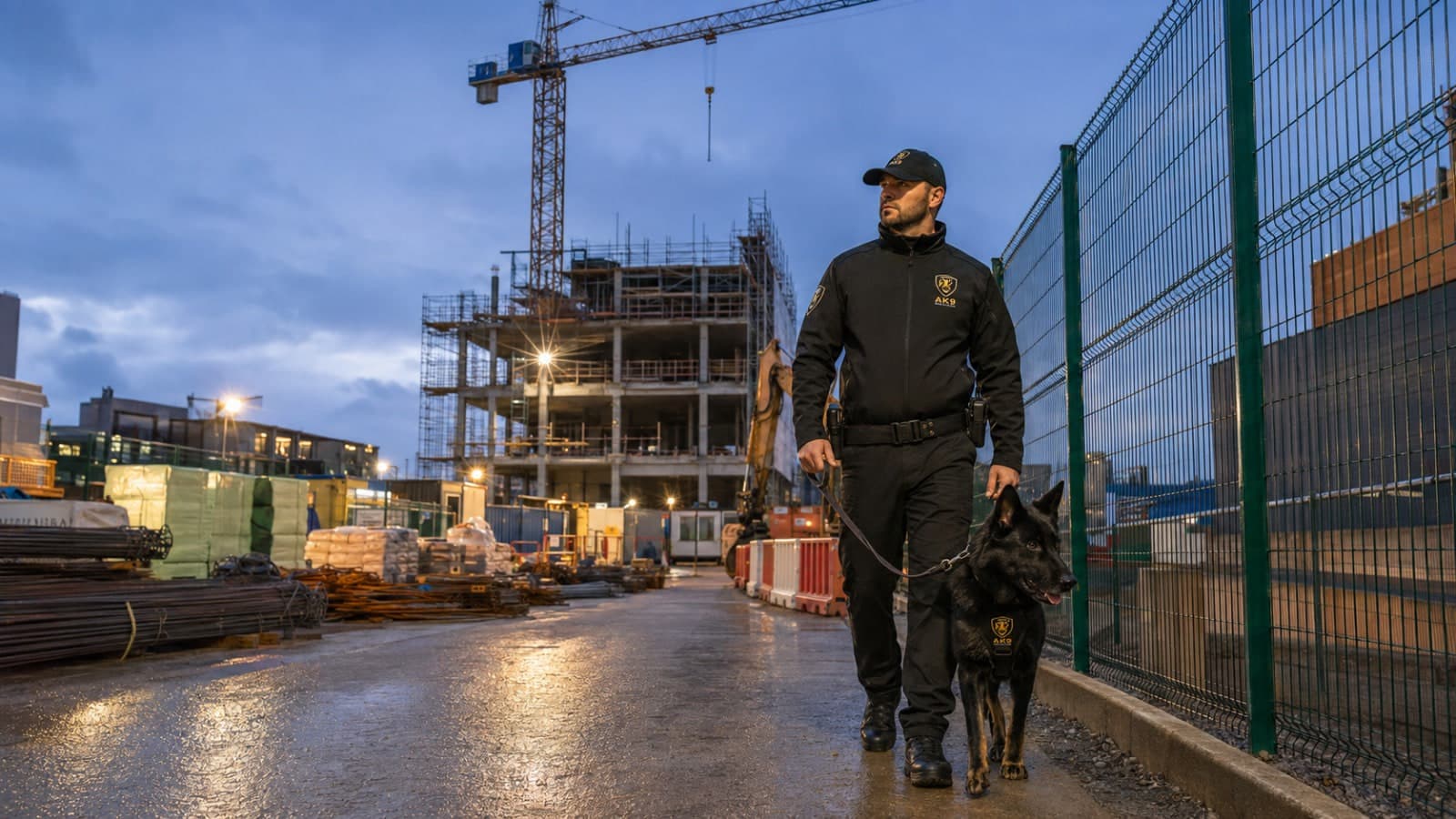
Why dog units suit construction sites
A part-built structure is the hardest kind of site to search. There are voids, stairwells, stacked material and plant to hide behind or inside, and at night a person with a torch will walk past someone concealed two metres away. A dog will not.
One handler and dog can also cover a perimeter that would need several static officers to watch properly, which is usually the difference between security that fits the budget and security that does not. Our handlers are NASDU-assessed and every deployment runs under BS 8517 and the Guard Dogs Act 1975, so a handler is present and in control throughout.
Gatehouse and access control during working hours
On active sites, controlling who comes in is often worth more than patrolling. We run signing-in procedures, check inductions and contractor credentials, log deliveries and vehicles, and hold the line on site rules that everybody finds inconvenient. An outside contractor is better placed to enforce those than one of your own team, precisely because they have no relationship to manage afterwards.
Where you already run a permit regime or need subcontractors escorted, we work to your process rather than layering our own paperwork on top of it.
Phased works and the fit-out problem
Risk moves as the job progresses. During groundworks the exposure is plant and fuel. By fit-out the building holds finished, portable, valuable items while access control is at its loosest and a dozen trades hold keys or codes. Losses at that stage are disproportionately internal or contractor-related, which makes logged access control more useful than perimeter patrol.
We adjust the deployment as the phase changes rather than quoting one arrangement for the whole programme.
What your insurer and your client will ask for
After an incident, the questions are always the same: who was on site, what time was the last patrol, what did it cover, and who was notified. If the answer is a signature on a sheet, a claim gets harder.
You get patrol logs with times and routes, incident reports with names and locations, and access records. Written to be handed to somebody else, because that is what they are for.
Sectors we provide this for
- Residential development
- Multi-plot sites alongside occupied housing, where neighbour relations shape the deployment.
- Commercial fit-out
- The phase where portable value peaks and access control matters most.
- Infrastructure and utilities
- Linear sites and compounds with no passing observation.
- Demolition and enabling works
- Plant, fuel and scrap value on sites with poor perimeters.
- Groundworks
- Plant and fuel exposure before any structure exists to secure.
- Logistics and industrial builds
- Large footprints where one dog unit replaces several static officers.
What construction sites usually get wrong
Most site security failures we are called in after are not a shortage of security. They are the wrong kind, or the right kind at a predictable time.
Cameras without monitoring
is the most common. Footage of your plant leaving is not security. If nobody is watching in real time, budget for a presence instead of more cameras.
A patrol at the same time nightly
stops being a deterrent and becomes a schedule. Planned theft is timed around visible security, so varied timing is not a nicety.
Cover that ends at fit-out
misses the phase with the highest portable value and the loosest access control. Losses often peak exactly when a site feels safest because it is nearly finished.
The cheapest effective arrangement on most sites is access control during working hours and a dog unit overnight, with the balance shifting as the phase changes. A survey costs nothing and will tell you which half of your current spend is doing the work.
Areas we cover for construction site security
We work across London, Hertfordshire, Bedfordshire and Buckinghamshire. These are the areas with a dedicated page, and there is local detail on each rather than the same text with the place name changed.
Theft from construction sites is planned around whatever security is visible. A patrol that runs at the same time every night is not a deterrent, it is a timetable.
Typical deployments
- Overnight and weekend cover for sites holding plant, cable and fuel
- Gatehouse, induction checks and delivery control during working hours
- Short-notice cover after a break-in while fencing or hoarding is repaired
- Fit-out and handover phases, where portable value peaks
- Groundworks and infrastructure compounds with no passing observation
- Multi-plot residential developments alongside occupied housing
Compliance
Officers hold current SIA licences and dog units operate under BS 8517 and the Guard Dogs Act 1975. Licence numbers for personnel assigned to your site are available on request, along with public liability certification for principal contractor records.
Tell us about the site
Send us the property, the hours you need covered and anything that has already happened there. We will come back with a survey date and an honest view of what the site actually needs.