
Support service
Key holding and alarm response services
Secure key holding, alarm response and property checks for commercial and residential premises across London and the Home Counties.
Key holding exists so that the person who gets out of bed at 3am is not you, and is not a member of your staff attending an unknown situation alone. We hold the keys, we attend the activation, and we tell you what we found.
It also removes a quieter risk. Where alarm response depends on whichever employee lives closest, that person is attending a potential crime scene without training, without a colleague, and usually without your insurer having ever agreed to it.
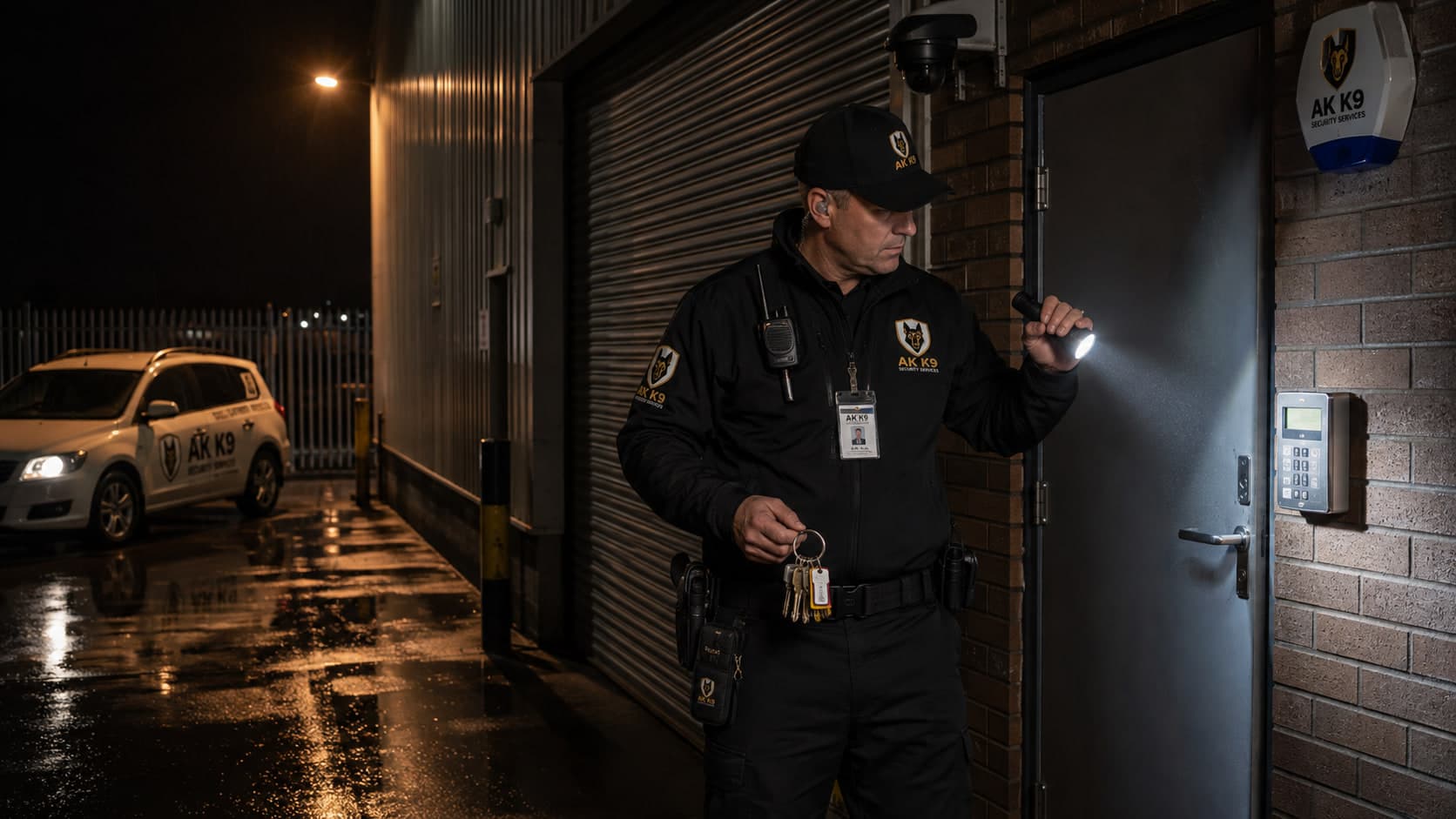
How keys are held
Keys are stored in a secured, access-controlled facility and identified by coded reference rather than by client name and address. A set of keys labelled with the property they open is a serious problem if it goes missing; a coded set is close to useless to anyone who takes it.
Every movement is logged: who drew the keys, when, for what, and when they came back. That record is what allows you to answer an insurer asking who had access on a given night.
Alarm response
On an activation we attend, carry out an external check first, and only enter once it is reasonable to do so. Entering a building blind because a bell is ringing is how people get hurt.
You get a report on what was found: a genuine intrusion, an insecurity such as a door left on the latch, an equipment fault, or a false activation with its likely cause. Repeat false activations are worth chasing down: they cost money, they erode response, and they usually have a fixable cause such as a sensor sited near a heater or a loose door.
Where a property is left insecure (a forced door, a broken window) we stay on site or arrange cover until it can be made secure, rather than locking up as best we can and leaving.
Property checks and contractor access
For vacant premises we carry out scheduled checks and report on the things that turn small problems into insurance claims: water ingress, a failed heating system in winter, accumulating mail signalling the property is empty, or evidence of attempted entry.
We also handle contractor access, so trades can be let in and supervised without you attending. Access is logged against the individual and the job, which matters when something is damaged or missing and the question of who was on site becomes contested.
Sectors we provide this for
- Property management
- Multi-site portfolios where local attendance by your own staff is impractical.
- Vacant property
- Key holding with scheduled condition checks, so voids are inspected as insurers require.
- Managed residential
- Contractor access to blocks without a manager attending to let people in.
- Commercial premises
- Out-of-hours alarm response so staff are off the emergency rota.
- Retail
- Opening and closing cover, and response to activations after trading hours.
- Construction
- Compound and welfare-unit keys, plus response during shutdown periods.
Key holding or your own staff on call: which makes sense?
Plenty of businesses handle alarm response in-house. Sometimes that is reasonable. Often it is a liability nobody has looked at properly.
Key holding fits when
attendance would otherwise fall to whoever lives nearest, when you have more than one site, or when your insurer has conditions about who may attend and how quickly. It also produces an audit trail, which in-house arrangements almost never do.
In-house response can work when
there is one site, a manager genuinely lives close, and the risk of attending is low. Be honest about that last point: an employee attending a possible break-in alone at 3am is a health-and-safety question, not just an inconvenience.
The hidden cost of in-house
is that it fails quietly. It goes on holiday, changes jobs, or does not answer. You find out on the night it matters.
If a single point of failure attending alone would trouble you in an incident report, outsource it. If you keep it in-house, at least check your insurer has agreed to the arrangement in writing.
Repeat false alarms are worth chasing down. They cost money, they erode the quality of response, and they almost always have a fixable physical cause.
Typical deployments
- Out-of-hours alarm response for commercial premises
- Vacant property key holding with scheduled condition checks
- Managed residential blocks needing contractor access control
- Multi-site portfolios where local response is impractical
- Landlords and agents wanting staff off the emergency rota
- Temporary key holding during refurbishment or void periods
Compliance
Key holding and alarm response are carried out by SIA-licensed personnel. Key movements are logged and auditable, and keys are identified by coded reference rather than by property address.
Tell us about the site
Send us the property, the hours you need covered and anything that has already happened there. We will come back with a survey date and an honest view of what the site actually needs.