
Monitoring service
CCTV monitoring and licensed control room operatives
SIA-licensed CCTV operatives providing live monitoring, incident escalation and evidential recording for commercial and industrial sites.
Cameras do not provide security. Cameras provide footage. The security comes from somebody watching in real time who can tell the difference between a fox and a person, and who knows what to do in the ninety seconds that actually matter.
Most sites discover this after an incident, when the recording turns out to show something unusable, or nothing at all because the relevant camera had been misaligned for weeks and nobody was looking.
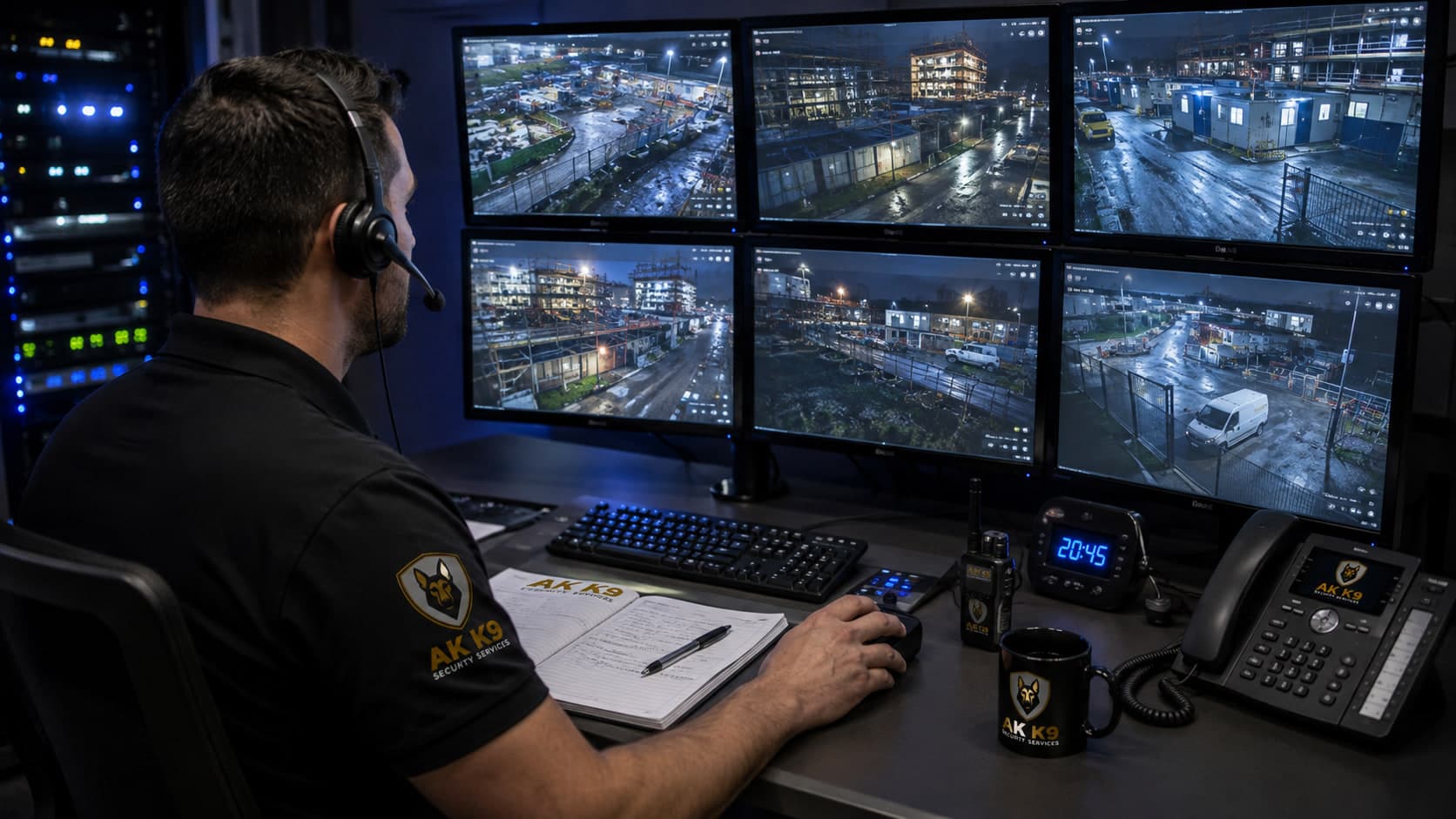
Live monitoring, not retrospective footage
Our operatives hold SIA Public Space Surveillance licences, the licence class specifically required for CCTV operation, which is a distinction some providers are vague about. They monitor your cameras live, assess what they are seeing, and escalate according to a procedure agreed with you in advance.
That procedure is the substance of the service. What justifies a call to a keyholder, what goes to a mobile response unit, what goes to the police, and what is simply logged, decided with you up front, so nothing depends on an operative guessing at the time.
Evidential standards
Footage is only useful if it stands up later. Operatives record what they observed, when, and what action followed, so the recording has a written account alongside it rather than being an orphan file somebody has to interpret months afterwards.
Where an incident is likely to lead to a claim or a prosecution, the sequence is preserved and handed over with a continuity record. Insurers and police ask for this, and its absence is a common reason claims stall.
Working with the system you already have
Most clients already own cameras and do not want to replace them. We monitor existing systems where they are capable of it, and tell you honestly where they are not: a camera pointed at a floodlight, or a recorder overwriting itself every eighteen hours, cannot be monitored into usefulness.
Where coverage genuinely has gaps, we will say which gaps matter for your risk rather than recommending a wholesale replacement. Combining monitoring with a patrol or dog unit is frequently cheaper and more effective than adding cameras to a site that has enough of them already.
Sectors we provide this for
- Industrial and warehousing
- Wide perimeters where cameras cover ground people cannot, provided somebody is watching them.
- Construction
- Hoarding-line and compound coverage, particularly between patrols.
- Vacant property
- Combined with key holding, so an activation gets a response rather than just a recording.
- Retail
- Loss prevention and evidential recording for prosecutions and insurance.
- Commercial premises
- Out-of-hours monitoring of access points and service areas.
- Events
- Temporary coverage alongside personnel on the ground.
Monitored CCTV or a physical presence: which does your site need?
Cameras and people are not substitutes for each other, and the honest answer is that cameras are usually the cheaper option and the weaker one.
Monitored CCTV fits when
the site is large, the risk is intrusion rather than process, and you need coverage of more ground than a person can walk. It is also the right answer where evidential recording matters for a claim or a prosecution.
A physical presence fits better when
intervention matters. An operative can call the police and a keyholder, but they cannot stop anything happening. If the loss occurs in the ninety seconds before anybody arrives, a camera only tells you how it happened.
Unmonitored recording is worth least
because it is retrospective by definition. It has a place for evidence and for insurance conditions, but it is not security and should not be priced or presented as though it were.
The strongest combination on most sites is monitored cameras plus a keyholder who can attend, or cameras plus a patrol. If the budget only covers one, ask what you actually need: prevention, or proof.
Cameras do not provide security. They provide footage. The security is somebody watching who knows what to do in the ninety seconds that matter.
Typical deployments
- Out-of-hours monitoring for commercial and industrial premises
- Construction site coverage where perimeter fencing is the main defence
- Vacant property watch combined with keyholding and alarm response
- Warehouse and yard monitoring across multiple entry points
- Temporary monitoring after a break-in or during high-risk works
- Event surveillance alongside on-the-ground personnel
Compliance
CCTV operatives hold current SIA Public Space Surveillance licences. Monitoring, retention and disclosure are handled in line with UK data protection requirements.
Tell us about the site
Send us the property, the hours you need covered and anything that has already happened there. We will come back with a survey date and an honest view of what the site actually needs.